


Page 361 - CyberSecurityEssentialsEnglish
P. 361
unapproved services, templates circulating with no owner or version, and results entering
         decisions that nobody can explain.

         The remedy is not a blanket prohibition, because an unrealistic ban pushes use into the
         shadows. Unrestricted access does not work either, because it treats improving the wording

         of  a  message  as  equivalent  to  evaluating  a  person  or  issuing  a  medical  or  legal
         recommendation.  What  is  required  is  turning  use  from  individual  initiatives  into  an

         institutional capability with a purpose, limits, measures, and responsibilities.

         That capability can be pictured as five connected components: valuable use cases, people
         who  hold  the  skill,  suitable  data  and  tools,  controls  proportionate  to  the  risk,  and  a
         mechanism of institutional learning that turns experiments into shared knowledge. If one

         component is missing, a clear problem appears: tools without use cases become a cost, use
         cases without training become errors, policies without support become neglected texts, and
         experiments without measurement become impressions.


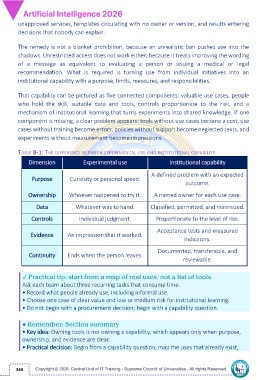
         TABLE 8-1: THE DIFFERENCE BETWEEN EXPERIMENTAL USE AND INSTITUTIONAL CAPABILITY

              Dimension               Experimental use                      Institutional capability


                                                                    A defined problem with an expected
               Purpose          Curiosity or personal speed.
                                                                                   outcome.

              Ownership         Whoever happened to try it.           A named owner for each use case.

                 Data              Whatever was to hand.            Classified, permitted, and minimized.


               Controls             Individual judgment.              Proportionate to the level of risk.

                                                                       Acceptance tests and measured
               Evidence        An impression that it worked.
                                                                                   indicators.

                                                                       Documented, transferable, and
              Continuity       Ends when the person leaves.
                                                                                  reviewable.


           ✓ Practical tip: start from a map of real uses, not a list of tools
           Ask each team about three recurring tasks that consume time.
           • Record what people already use, including informal use.
           • Choose one case of clear value and low or medium risk for institutional learning.
           • Do not begin with a procurement decision; begin with a capability question.


           ● Remember: Section summary
           • Key idea: Owning tools is not owning a capability, which appears only when purpose,
           ownership, and evidence are clear.
           • Practical decision: Begin from a capability question, map the uses that already exist,


        360

