


Page 191 - CyberSecurityEssentialsEnglish
P. 191
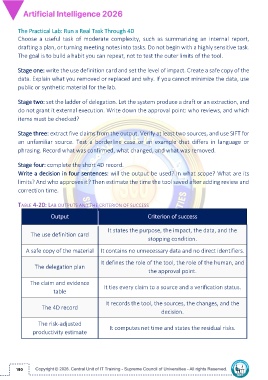
The Practical Lab: Run a Real Task Through 4D
         Choose  a  useful  task  of  moderate  complexity,  such  as  summarizing  an  internal  report,
         drafting a plan, or turning meeting notes into tasks. Do not begin with a highly sensitive task.

         The goal is to build a habit you can repeat, not to test the outer limits of the tool.

         Stage one: write the use definition card and set the level of impact. Create a safe copy of the
         data. Explain what you removed or replaced and why. If you cannot minimize the data, use
         public or synthetic material for the lab.


         Stage two: set the ladder of delegation. Let the system produce a draft or an extraction, and
         do not grant it external execution. Write down the approval point: who reviews, and which
         items must be checked?

         Stage three: extract five claims from the output. Verify at least two sources, and use SIFT for
         an  unfamiliar  source.  Test  a  borderline  case  or  an  example  that  differs  in  language  or

         phrasing. Record what was confirmed, what changed, and what was removed.

         Stage four: complete the short 4D record.
         Write a decision in four sentences: will the output be used? In what scope? What are its

         limits? And who approves it? Then estimate the time the tool saved after adding review and
         correction time.

         TABLE 4-20: LAB OUTPUTS AND THE CRITERION OF SUCCESS

                        Output                                     Criterion of success


                                                 It states the purpose, the impact, the data, and the
               The use definition card
                                                                   stopping condition.


             A safe copy of the material  It contains no unnecessary data and no direct identifiers.

                                              It defines the role of the tool, the role of the human, and
                 The delegation plan
                                                                   the approval point.


              The claim and evidence
                                               It ties every claim to a source and a verification status.
                         table

                                                It records the tool, the sources, the changes, and the
                    The 4D record
                                                                         decision.

                  The risk-adjusted
                                                  It computes net time and states the residual risks.
                productivity estimate


        190

