


Page 195 - CyberSecurityEssentialsEnglish
P. 195
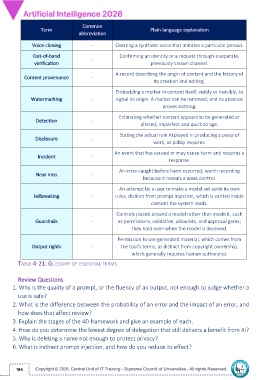
Common
                   Term                                             Plain-language explanation
                                    abbreviation

               Voice cloning              -         Creating a synthetic voice that imitates a particular person.

                Out-of-band                           Confirming an identity or a request through a separate,
                                          -
                verification                                        previously known channel.

                                                    A record describing the origin of content and the history of
            Content provenance            -
                                                                     its creation and editing.

                                                    Embedding a marker in content itself, visibly or invisibly, to
               Watermarking               -          signal its origin. A marker can be removed, and its absence
                                                                         proves nothing.

                                                      Estimating whether content appears to be generated or
                 Detection                -
                                                                altered; imperfect and quick to age.

                                                      Stating the actual role AI played in producing a piece of
                 Disclosure               -
                                                                     work, as policy requires.

                                                    An event that has caused or may cause harm and requires a
                  Incident                -
                                                                            response.

                                                      An error caught before harm occurred, worth recording
                 Near miss                -
                                                                 because it reveals a weak control.

                                                      An attempt by a user to make a model set aside its own
                Jailbreaking              -         rules, distinct from prompt injection, which is carried inside
                                                                    content the system reads.

                                                     Controls placed around a model rather than inside it, such
                 Guardrails               -          as permissions, validation, allowlists, and approval gates;
                                                            they hold even when the model is deceived.

                                                     Permission to use generated material, which comes from
               Output rights              -            the tool’s terms, as distinct from copyright ownership,
                                                            which generally requires human authorship.
         TABLE 4-21: GLOSSARY OF ESSENTIAL TERMS


         Review Questions
       1. Why is the quality of a prompt, or the fluency of an output, not enough to judge whether a
         use is safe?

       2. What is the difference between the probability of an error and the impact of an error, and
         how does that affect review?
       3. Explain the stages of the 4D framework and give an example of each.
       4. How do you determine the lowest degree of delegation that still delivers a benefit from AI?

       5. Why is deleting a name not enough to protect privacy?
       6. What is indirect prompt injection, and how do you reduce its effect?


        194

