


Page 169 - CyberSecurityEssentialsEnglish
P. 169
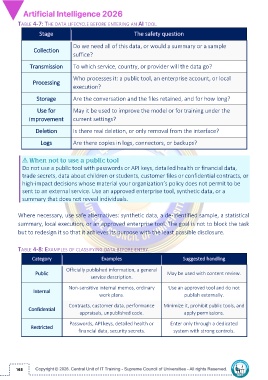
TABLE 4-7: THE DATA LIFECYCLE BEFORE ENTERING AN AI TOOL

                   Stage                                     The safety question

                                  Do we need all of this data, or would a summary or a sample
                Collection
                                  suffice?


              Transmission        To which service, country, or provider will the data go?

                                  Who processes it: a public tool, an enterprise account, or local
                Processing
                                  execution?


                 Storage          Are the conversation and the files retained, and for how long?

                  Use for         May it be used to improve the model or for training under the
              improvement         current settings?


                 Deletion         Is there real deletion, or only removal from the interface?

                   Logs           Are there copies in logs, connectors, or backups?


           ⚠ When not to use a public tool

           Do not use a public tool with passwords or API keys, detailed health or financial data,
           trade secrets, data about children or students, customer files or confidential contracts, or
           high-impact decisions whose material your organization’s policy does not permit to be
           sent to an external service. Use an approved enterprise tool, synthetic data, or a
           summary that does not reveal individuals.


         Where necessary, use safe alternatives: synthetic data, a de-identified sample, a statistical
         summary, local execution, or an approved enterprise tool. The goal is not to block the task

         but to redesign it so that it achieves its purpose with the least possible disclosure.

         TABLE 4-8: EXAMPLES OF CLASSIFYING DATA BEFORE ENTRY

               Category                       Examples                            Suggested handling

                               Officially published information, a general
                 Public                                                    May be used with content review.
                                         service description.

                                Non-sensitive internal memos, ordinary      Use an approved tool and do not
                Internal
                                             work plans.                           publish externally.

                                Contracts, customer data, performance     Minimize it, prohibit public tools, and
              Confidential
                                    appraisals, unpublished code.                  apply permissions.

                                Passwords, API keys, detailed health or      Enter only through a dedicated
               Restricted
                                    financial data, security secrets.         system with strong controls.


        168

