


Page 167 - CyberSecurityEssentialsEnglish
P. 167
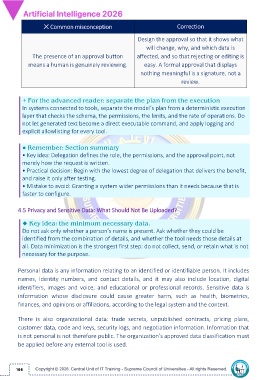
✕ Common misconception                                      Correction

                                                              Design the approval so that it shows what
                                                                  will change, why, and which data is

                The presence of an approval button            affected, and so that rejecting or editing is
              means a human is genuinely reviewing.              easy. A formal approval that displays

                                                               nothing meaningful is a signature, not a
                                                                                  review.


           + For the advanced reader: separate the plan from the execution
           In systems connected to tools, separate the model’s plan from a deterministic execution
           layer that checks the schema, the permissions, the limits, and the rate of operations. Do
           not let generated text become a direct executable command, and apply logging and

           explicit allowlisting for every tool.


           ● Remember: Section summary
           • Key idea: Delegation defines the role, the permissions, and the approval point, not
           merely how the request is written.
           • Practical decision: Begin with the lowest degree of delegation that delivers the benefit,

           and raise it only after testing.
           • Mistake to avoid: Granting a system wider permissions than it needs because that is
           faster to configure.

         4.5 Privacy and Sensitive Data: What Should Not Be Uploaded?


           ◆ Key idea: the minimum necessary data.
           Do not ask only whether a person’s name is present. Ask whether they could be
           identified from the combination of details, and whether the tool needs those details at
           all. Data minimization is the strongest first step: do not collect, send, or retain what is not

           necessary for the purpose.


         Personal data is any information relating to an identified or identifiable person. It includes
         names,  identity  numbers,  and  contact  details,  and  it  may  also  include  location,  digital

         identifiers,  images  and  voice,  and  educational  or  professional  records.  Sensitive  data  is
         information  whose  disclosure  could  cause  greater  harm,  such  as  health,  biometrics,

         finances, and opinions or affiliations, according to the legal system and the context.

         There  is  also  organizational  data:  trade  secrets,  unpublished  contracts,  pricing  plans,
         customer data, code and keys, security logs, and negotiation information. Information that
         is not personal is not therefore public. The organization’s approved data classification must

         be applied before any external tool is used.


        166

