


Page 149 - CyberSecurityEssentialsEnglish
P. 149
evaluation  set,  repeated  runs,  an  error  taxonomy,  a  total  cost,  and  a  test  designed
         specifically for Arabic.

         A good decision remains provisional. Models, interfaces, prices, policies, and knowledge
         bases all change. The selection process therefore does not end at purchase or adoption; one

         cycle ends and a cycle of monitoring and re-evaluation begins. In the next chapter the book
         moves from the question “which tool is right?” to the question “how do I use it safely without

         losing control?”


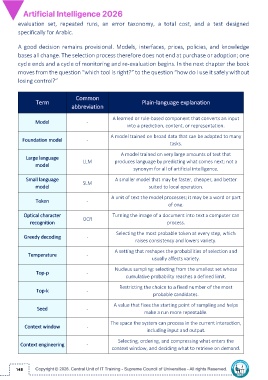
                                   Common
                 Term                                           Plain-language explanation
                                 abbreviation

                                                   A learned or rule-based component that converts an input
                 Model                  -
                                                          into a prediction, content, or representation.

                                                  A model trained on broad data that can be adapted to many
           Foundation model             -
                                                                             tasks.

                                                       A model trained on very large amounts of text that
             Large language
                                      LLM           produces language by predicting what comes next; not a
                 model
                                                            synonym for all of artificial intelligence.

             Small language                         A smaller model that may be faster, cheaper, and better
                                      SLM
                 model                                             suited to local operation.

                                                  A unit of text the model processes; it may be a word or part
                 Token                  -
                                                                            of one.

            Optical character                      Turning the image of a document into text a computer can
                                      OCR
              recognition                                                  process.

                                                     Selecting the most probable token at every step, which
            Greedy decoding             -
                                                             raises consistency and lowers variety.

                                                    A setting that reshapes the probabilities of selection and
              Temperature               -
                                                                     usually affects variety.

                                                    Nucleus sampling: selecting from the smallest set whose
                 Top-p                  -
                                                         cumulative probability reaches a defined limit.

                                                      Restricting the choice to a fixed number of the most
                 Top-k                  -
                                                                     probable candidates.

                                                    A value that fixes the starting point of sampling and helps
                  Seed                  -
                                                                 make a run more repeatable.

                                                  The space the system can process in the current interaction,
            Context window              -
                                                                  including input and output.

                                                      Selecting, ordering, and compressing what enters the
          Context engineering           -
                                                   context window, and deciding what to retrieve on demand.


        148

