


Page 148 - CyberSecurityEssentialsEnglish
P. 148
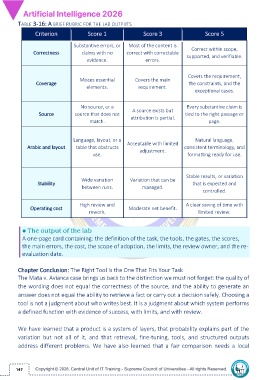
TABLE 3-16: A BRIEF RUBRIC FOR THE LAB OUTPUTS

                 Criterion              Score 1                  Score 3                    Score 5

                                  Substantive errors, or   Most of the content is
                                                                                      Correct within scope,
                Correctness          claims with no      correct with correctable
                                                                                    supported, and verifiable.
                                        evidence.                 errors.


                                                                                     Covers the requirement,
                                     Misses essential        Covers the main
                 Coverage                                                            the constraints, and the
                                        elements.              requirement.
                                                                                        exceptional cases.


                                     No source, or a                                Every substantive claim is
                                                            A source exists but
                  Source          source that does not                             tied to the right passage or
                                                           attribution is partial.
                                         match.                                               page.


                                  Language, layout, or a                                Natural language,
                                                          Acceptable with limited
             Arabic and layout     table that obstructs                            consistent terminology, and
                                                               adjustment.
                                          use.                                      formatting ready for use.


                                                                                    Stable results, or variation
                                     Wide variation        Variation that can be
                  Stability                                                            that is expected and
                                     between runs.              managed.
                                                                                           controlled.


                                    High review and                                 A clear saving of time with
               Operating cost                             Moderate net benefit.
                                         rework.                                         limited review.


           ● The output of the lab
           A one-page card containing: the definition of the task, the tools, the gates, the scores,
           the main errors, the cost, the scope of adoption, the limits, the review owner, and the re-
           evaluation date.


         Chapter Conclusion: The Right Tool Is the One That Fits Your Task
         The Mata v. Avianca case brings us back to the distinction we must not forget: the quality of
         the wording does not equal the correctness of the source, and the ability to generate an

         answer does not equal the ability to retrieve a fact or carry out a decision safely. Choosing a
         tool is not a judgment about who writes best. It is a judgment about which system performs

         a defined function with evidence of success, with limits, and with review.

         We have learned that a product is a system of layers, that probability explains part of the

         variation  but  not  all  of  it,  and  that  retrieval,  fine-tuning,  tools,  and  structured  outputs
         address  different  problems.  We  have  also  learned  that  a  fair  comparison  needs  a  local


        147

