


Page 140 - CyberSecurityEssentialsEnglish
P. 140
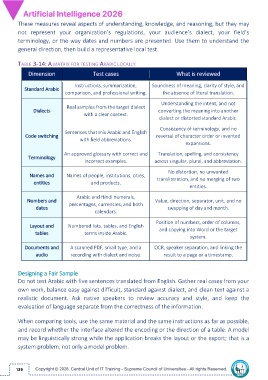
These measures reveal aspects of understanding, knowledge, and reasoning, but they may
         not  represent  your  organization’s  regulations,  your  audience’s  dialect,  your  field’s
         terminology, or the way dates and numbers are presented. Use them to understand the

         general direction, then build a representative local test.

         TABLE 3-14: A MATRIX FOR TESTING ARABIC LOCALLY

              Dimension                   Test cases                           What is reviewed

                                  Instructions, summarization,       Soundness of meaning, clarity of style, and
            Standard Arabic
                              comparison, and professional writing.      the absence of literal translation.

                                                                         Understanding the intent, and not
                               Real samples from the target dialect
                Dialects                                               converting the meaning into another
                                      with a clear context.
                                                                        dialect or distorted standard Arabic.

                                                                        Consistency of terminology, and no
                              Sentences that mix Arabic and English
            Code switching                                            reversal of character order or invented
                                    with field abbreviations.
                                                                                    expansions.

                              An approved glossary with correct and    Translation, spelling, and consistency
              Terminology
                                       incorrect examples.            across singular, plural, and abbreviation.

                                                                            No distortion, no unwanted
              Names and        Names of people, institutions, cities,
                                                                       transliteration, and no merging of two
                entities                 and products.
                                                                                     entities.

                                   Arabic and Hindi numerals,
             Numbers and                                              Value, direction, separator, unit, and no
                                percentages, currencies, and both
                 dates                                                     swapping of day and month.
                                           calendars.

                                                                      Position of numbers, order of columns,
              Layout and       Numbered lists, tables, and English
                                                                        and copying into Word or the target
                 tables                terms inside Arabic.
                                                                                     system.

            Documents and       A scanned PDF, small type, and a      OCR, speaker separation, and linking the
                 audio          recording with dialect and noise.         result to a page or a timestamp.


         Designing a Fair Sample
         Do not test Arabic with five sentences translated from English. Gather real cases from your
         own work, balance easy against difficult, standard against dialect, and clean text against a

         realistic  document.  Ask  native  speakers  to  review  accuracy  and  style,  and  keep  the
         evaluation of language separate from the correctness of the information.

         When comparing tools, use the same material and the same instructions as far as possible,
         and record whether the interface altered the encoding or the direction of a table. A model

         may be linguistically strong while the application breaks the layout or the export; that is a
         system problem, not only a model problem.


        139

